
Advanced Search 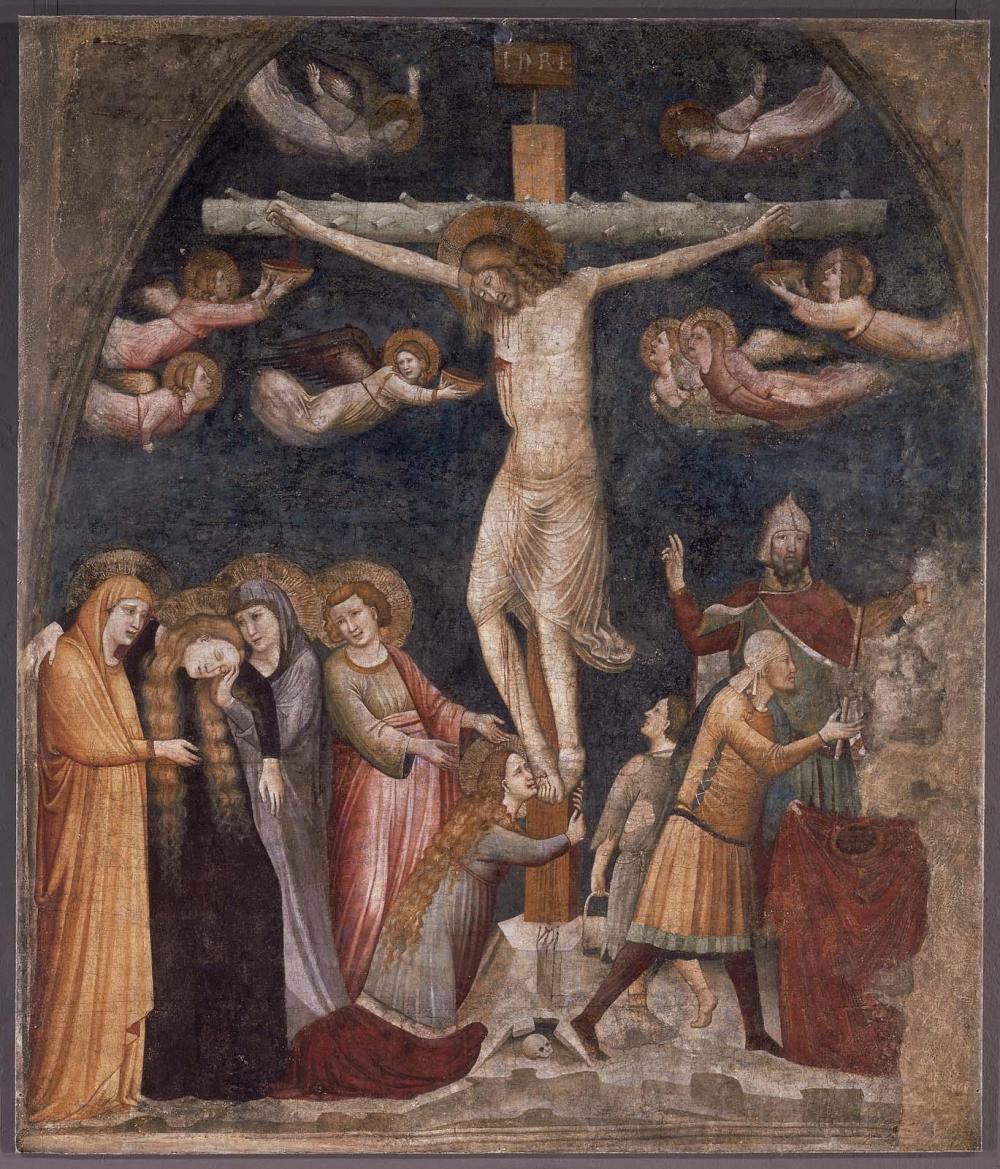

View: Overall
The Crucifixion
Master of the Urbino Coronation (Italian (Riminese), active about 1340–1380)
1360s
Medium/Technique
Fresco transferred to canvas
Dimensions
337.8 x 275.6 cm (133 x 108 1/2 in.)
Credit Line
Augustus Hemenway Fund
Accession Number40.91
CollectionsEurope
ClassificationsPaintings
Frescoes are executed by applying pigments to fresh plaster. The Crucifixion is one of only a handful of detached frescoes from this period and of this size in American museums. It was created for a wall in the Church of Santa Lucia del Mercato, in Fabriano, central Italy, and was removed in the late 19th century. The unidentified artist’s name comes from a painting in the same style now in a museum in Urbino. His art, like that of his important predecessor Giotto, is distinguished by direct emotional appeal and a preference for imposing, substantial bodies.
ProvenancePossibly from the church of San Giovanni Battista, Fabriano, Italy. By 1893 until at least 1916, Ferruccio Tartuferi (b. 1852 - d. 1925), Fabriano and Bologna [see note 1]. April 23, 1929, sold by Publio Podio, Bologna, through Enrico Testa and Pietro Tozzi, to the Brummer Gallery, New York (stock no. P5844) [see note 2]; December 17, 1929, sold by the Brummer Gallery to William Randolph Hearst (b. 1863 - d. 1951), New York and Los Angeles; April 19, 1940, sold by Hearst, through Parish-Watson and Co., New York, to the Brummer Gallery (stock no. N4560); 1940, sold by Brummer to the MFA for $15,500. (Accession Date: April 11, 1940)
NOTES:
[1] Between 1894 and 1916, Tartuferi kept this fresco in Rome at the Palazzo Corsini, the Castel Sant'Angelo, and the Collegio di Sant'Antonio. On its early provenance, see Enzo Borsellino, "Mercato dell'arte e tutela dopo l'Unità: il caso degli affreschi del Maestro dell'Incoronazione di Urbino," in Mosaico: Temi e Metodi d'Arte e Critica per Gianni Carlo Sciolla (Naples, 2012), vol. 2, pp. 513-524. The church of John the Baptist was located near the residence of the Tartuferi family in Fabriano. Other frescoes from the same cycle, representing the Annunciation to Zacharias and the Birth of the Baptist, are today at the Memorial Art Gallery, University of Rochester, and the Galleria Nazionale d'Arte Antica, Rome. It is not known precisely when they were removed and transferred to canvas, but it must have been no later than the 1860s, when the church was destroyed.
[2] According to a letter from Joseph Brummer to W. G. Constable (May 3, 1940), the fresco was purchased from Professor Podio in Bologna. The Brummer stock card clarifies that it was purchased from Testa, with a percentage going to Tozzi.
NOTES:
[1] Between 1894 and 1916, Tartuferi kept this fresco in Rome at the Palazzo Corsini, the Castel Sant'Angelo, and the Collegio di Sant'Antonio. On its early provenance, see Enzo Borsellino, "Mercato dell'arte e tutela dopo l'Unità: il caso degli affreschi del Maestro dell'Incoronazione di Urbino," in Mosaico: Temi e Metodi d'Arte e Critica per Gianni Carlo Sciolla (Naples, 2012), vol. 2, pp. 513-524. The church of John the Baptist was located near the residence of the Tartuferi family in Fabriano. Other frescoes from the same cycle, representing the Annunciation to Zacharias and the Birth of the Baptist, are today at the Memorial Art Gallery, University of Rochester, and the Galleria Nazionale d'Arte Antica, Rome. It is not known precisely when they were removed and transferred to canvas, but it must have been no later than the 1860s, when the church was destroyed.
[2] According to a letter from Joseph Brummer to W. G. Constable (May 3, 1940), the fresco was purchased from Professor Podio in Bologna. The Brummer stock card clarifies that it was purchased from Testa, with a percentage going to Tozzi.